
 By
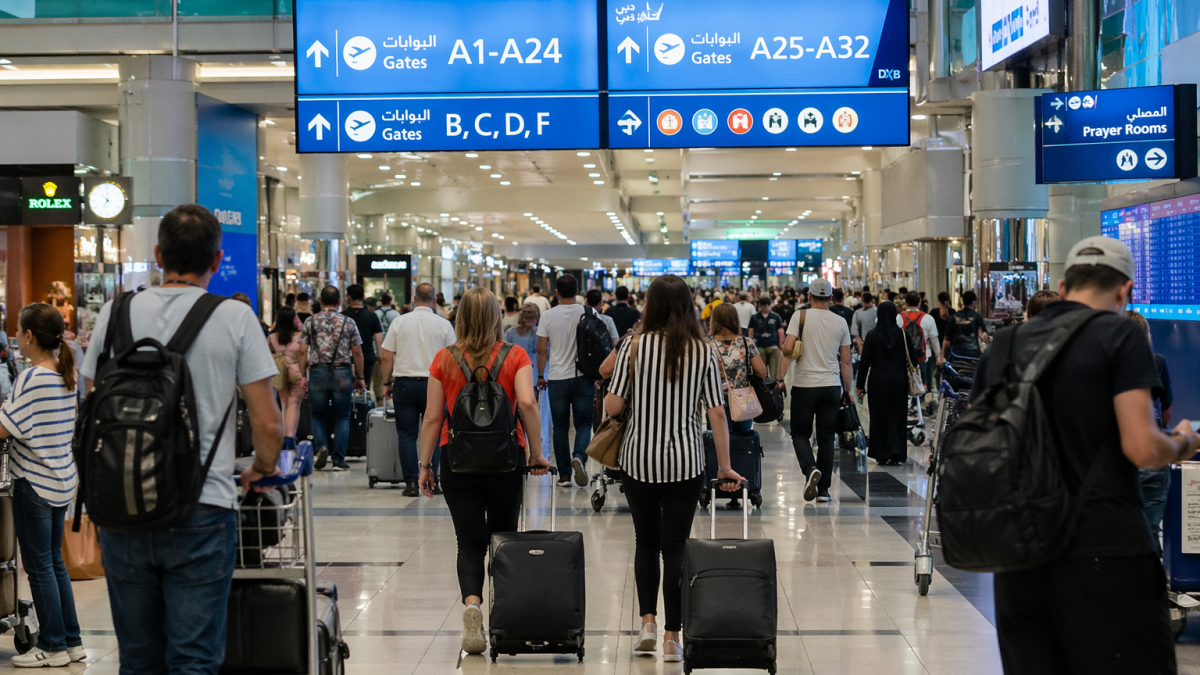
By The war involving Iran has unsettled one of the Gulf’s most stable expatriate hubs, triggering a notable outflow of British residents from the United Arab Emirates.
However, rather than returning to the United Kingdom, many are opting for alternative destinations in Europe, underscoring deeper concerns around taxation, lifestyle, and long-term financial planning.
The shift highlights how geopolitical tensions can reshape migration patterns among globally mobile professionals, particularly those with the means to relocate quickly.
Security fears prompt departures from UAE
Data cited by the Financial Times suggests that roughly one in eight Britons living in the UAE around 30,000 people have left since hostilities began on February 28.
Before the conflict, the British population in the country stood at about 240,000.
The departures appear to be driven largely by rising anxiety over regional instability.
While the UAE has historically been viewed as insulated from wider Middle East tensions, repeated alerts and strikes on civilian areas have dented that perception.
Nigel Lea, a security consultant based in Dubai, said, “Many Brits have chosen to relocate temporarily to alleviate anxiety and share childcare and schooling with a home country support network.”
He was speaking to the Financial Times.
Dubai, in particular, has long relied on expatriates, who make up the bulk of its population and workforce.
The sudden outflow raises questions about how sustained geopolitical instability could affect the city’s appeal.
Europe emerges as a preferred alternative
Despite the exodus, Britain is not the primary destination for those leaving the UAE.
Reports from CNBC indicate that many families are instead relocating to other European countries, including Switzerland, Spain and Portugal.
These locations offer a mix of perceived safety, favourable tax regimes, and quality of life.
Wealthy individuals, in particular, are said to be avoiding a return to the UK due to concerns over higher tax liabilities.
According to The Independent and The Guardian, some high-net-worth Britons are deliberately choosing to wait out the conflict elsewhere in Europe rather than re-establish tax residency in Britain.
Tax changes deter return to the UK
Tax policy has emerged as a central factor influencing relocation decisions.
The UAE’s zero personal income and capital gains tax regime contrasts sharply with recent changes in the UK.
London has overhauled its long-standing “non-domiciled” tax system, replacing it with a residence-based model that subjects long-term residents to taxation on global income and gains.
While new arrivals who have spent a decade abroad can benefit from a limited four-year exemption, the overall framework represents a significant tightening.
For many expatriates accustomed to tax-efficient structures, the shift reduces the financial appeal of returning to Britain, even amid geopolitical uncertainty.
UK government seeks to attract returning expats
The UK government is attempting to capitalise on the situation by positioning the country as a stable economic base.
Rachel Reeves, the UK’s finance minister, recently highlighted the country’s competitive tax environment and investment incentives.
“We have the lowest rate of corporation tax in the G7,” she said during a conversation with CNBC’s Sara Eisen at the “Invest in America” forum.
She also pointed to measures aimed at encouraging companies to list in London, including temporary exemptions from stamp duty.
Officials hope to market Britain as a “safe harbour economy” for globally mobile professionals, although it remains unclear whether this will be enough to offset concerns over personal taxation.
Global mobility reshapes expat decisions
Experts say the current trend reflects a broader shift in how affluent individuals approach relocation.
Rather than reacting impulsively to crises, many are making strategic decisions based on long-term considerations.
Dominic Volek, group head of private clients at Henley & Partners told CNBC, “Situations like this reinforce a core principle we often discuss with clients: the value of global optionality.”
He added that “internationally mobile families” typically maintain options across multiple regions, including Europe, the Americas, the Middle East and Asia.
“These decisions are generally strategic and long-term in nature rather than reactions to short-term events,” he said.
Return to UAE likely if tensions ease
Despite the recent departures, analysts do not expect a permanent shift away from the UAE.
Dubai’s appeal, rooted in its tax advantages, infrastructure and lifestyle, remains intact.
Many of those who have left are believed to be adopting a wait-and-watch approach, with the possibility of returning if tensions in the region subside.
For now, however, the conflict has introduced a new layer of uncertainty, prompting even the most globally mobile residents to reassess their options.
The post Iran conflict drives British expat exodus from UAE, but few return home appeared first on Invezz
